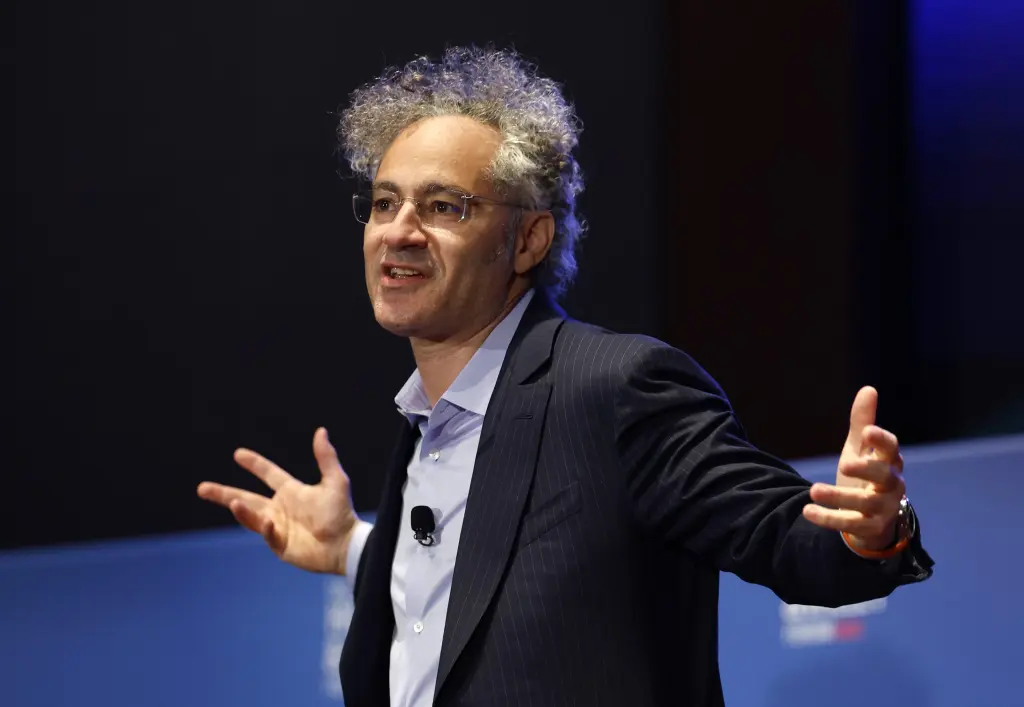
Alex Karp, chief executive of Palantir, told a room of marketing executives this week a story most CEOs would not volunteer. Ted Mabrey, who now runs Palantir's commercial business, once pulled him aside and told him to stop talking up Foundry, the company's flagship data platform, because it was wearing on employees who had to hear him boast about it constantly.
The conversation that stuck, for about six months
Please stop talking to Palantirians about how big Foundry is going to be, Karp recalled Mabrey telling him. It's depressing, and everybody knows you're out of touch. Karp said the advice actually landed, for a while. I had stopped talking to people for, like, six months, he said, speaking Thursday alongside Zeta Global CEO David Steinberg at Zeta Live '26, Zeta's annual AI marketing conference.
Why he keeps ignoring the warning anyway
Karp described a decision making style that regularly puts him at odds with his own team. I have an aesthetic idea of what could work and what won't work, he said. About once a month, I have some idea that I think is important, and then I know it's important. Everyone tells me, we can never do that. He said he relies on colleagues he has worked with for years to tell him the truth, calling those relationships very harsh, and joked, in fact, I often tell them, can you tell me something I want to hear, please.
What Foundry actually is, and why the hype has receipts
Foundry is Palantir's platform for pulling a company's data into one place and controlling who can see it, and it now sits at the center of the company's fastest growing business. U.S. commercial revenue grew 149 percent year over year to 764 million dollars in the second quarter, and Palantir has since raised its full year U.S. commercial revenue guidance to more than 3.4 billion dollars, a growth rate of at least 134 percent. After those results, Karp told investors, for the first time people believe us, a line that complicates the out of touch criticism rather than confirming it.
The brand argument underneath all the hype
Karp also used the talk to explain why Palantir struggled to raise money in its early years, saying the company refused to build software the way investors wanted. Normal software is built to force you to adopt something that's parasitic, he said. They take every one of those things, turn it into a commodity, and sell it to everyone else. He said investors wanted to hear that clients would be unhappy but unable to leave. Sticky is a metaphor for parasitic, he said. I get your data. I get it into something you can't get rid of. The thing turns into something I can sell to everybody else. According to Karp, venture capitalists directly asked him, where's the parasite. Palantir's refusal to build that kind of lock in is, in effect, its entire positioning against a software industry largely built around vendor dependency.
A once mocked model that's now being copied
Palantir was also mocked early on for sending its own engineers to work inside client companies, a practice it calls forward deployed engineering. That model has since become one of the fastest growing job categories in Silicon Valley. Zeta's Steinberg, sharing the stage with Karp, said his own company copied the approach directly. We pivoted a huge part of our business to follow you guys on this because it's so freaking efficient, he said. The two companies also announced a seven year partnership in June under which Zeta's Data Cloud is being rebuilt on Foundry, a deal Steinberg told Adweek would bring in over 100 million dollars a year in sales within about a year.
Not everyone's cup of tea, and he knows it
Palantir employs about 4,500 people, and Karp readily admits the culture is not everyone's cup of tea. Some of the company's best references, he said, come from former staff who left after another crazy lecture from Karp and later wanted to come back. In March, Mabrey publicly called on former hobbits to return to the Shire, a reference to The Lord of the Rings, the source of Palantir's name, an unusually self aware bit of internal brand humor for a company this large.
Why Karp thinks bad execution is now fatal, not just costly
Karp closed with a broader argument about AI, that poor execution now carries consequences it never used to. In the past, he said, a second rate software rollout cost a company time and money but rarely sank it if the business had a strong enough moat. He used defense as his example, a German government will buy a German missile even if it's B minus because it flies and it's German, but a missile that can no longer hit its target against better equipped opponents does not clear the bar once an AI application layer decides the outcome. Your B minus missile is a triple plus with this, and your A plus missile is useless, he said, so that's just binary. His advice to the CEOs in the room was to identify what makes their business special, get full visibility from the factory floor to the cost of goods, and use AI to strengthen that edge without letting a rival or the AI model provider itself learn how it works. If your person down the street gets it right, even if they're inferior to you, just like the missile, they will outperform you, he said.
The real story isn't the hype, it's the bet behind it
What ties this story together is not Foundry's growth numbers on their own. It is Karp's underlying bet that conviction, stated loudly enough to annoy your own staff, is a brand asset rather than a liability, as long as the product eventually proves the hype right.