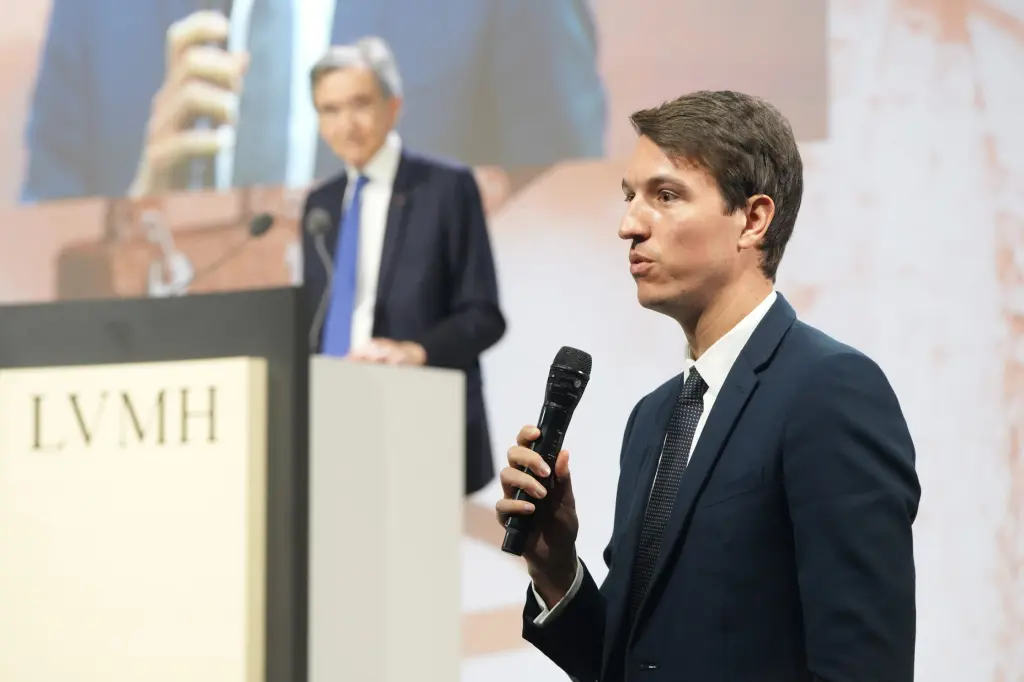
Nike announced Wednesday that Alexandre Arnault is joining its board of directors, a notable addition for a company that has shed roughly 200 billion dollars in market value and was recently dropped from the S&P 100. At 34, Arnault is young for a board seat at a company Nike's size, but his résumé is exactly the kind of thing a struggling brand goes looking for when the problem is not the balance sheet, it is relevance.
Who Nike just brought into the room
Arnault currently helps oversee LVMH's wines and spirits division. Before that, he served as chief executive of Rimowa, the luxury luggage maker, where he modernized the brand's retail stores and struck collaborations with Supreme and Off-White, pairings designed to make a century old suitcase brand feel current to a much younger customer. Before Rimowa, he ran product and communications at Tiffany, a stretch that included orchestrating the jeweler's streetwear collaboration with Nike itself, along with a run of high profile marketing campaigns that reshaped how the brand talked to a newer audience.
Why Nike needed exactly this résumé
Nike CEO Elliott Hill said Arnault's experience across innovation, digital transformation, and brand building will be an asset to the company. The specific skill Nike appears to be buying is not luxury pedigree for its own sake, it is a demonstrated pattern of taking heritage brands that had started to feel dated and making them feel essential again to a new generation of shoppers, which is precisely the problem Nike is living through right now.
The numbers behind the urgency
The pressure on Nike is not abstract. Fourth quarter revenue fell 1 percent to 11 billion dollars, Nike Direct sales dropped 7 percent, and digital sales fell 12 percent. Sales in China have now declined for eight consecutive quarters. Meanwhile, competitors including Hoka, On, and New Balance have taken over a level of cultural relevance in running and lifestyle categories that Nike used to define outright, not just compete in.
A reminder that LVMH has its own soft spots
The appointment also lands at a moment when LVMH itself is not immune to slowdown. Its Fashion and Leather Goods division posted a 1 percent organic revenue decline and a 7 percent drop in profit, a sign that even the conglomerate that essentially wrote the modern brand house playbook is feeling some fatigue in its core business. Arnault's own division, wines and spirits, grew 5 percent organically over the same period, which strengthens the case that he has a track record of growing a legacy category rather than simply managing one that was already working.
The succession subtext
There is also a quieter storyline running underneath this one. Bernard Arnault is 77, and his five children are spread across different parts of the LVMH empire in roles widely read as an extended audition for who eventually runs the larger group. A visible outside board seat at a company as prominent as Nike inevitably gets read partly through that lens, a public proving ground, whether or not that was the primary intention behind the appointment.
What this actually signals
A board seat does not redesign a shoe line, fix a supply chain, or reverse eight quarters of decline in China on its own. What it does is signal what kind of turnaround Nike believes it needs, one built on brand relevance and cultural credibility rather than pricing, distribution, or product cycles alone. That choice, on its own, says a great deal about how seriously Nike now views the size of its problem.