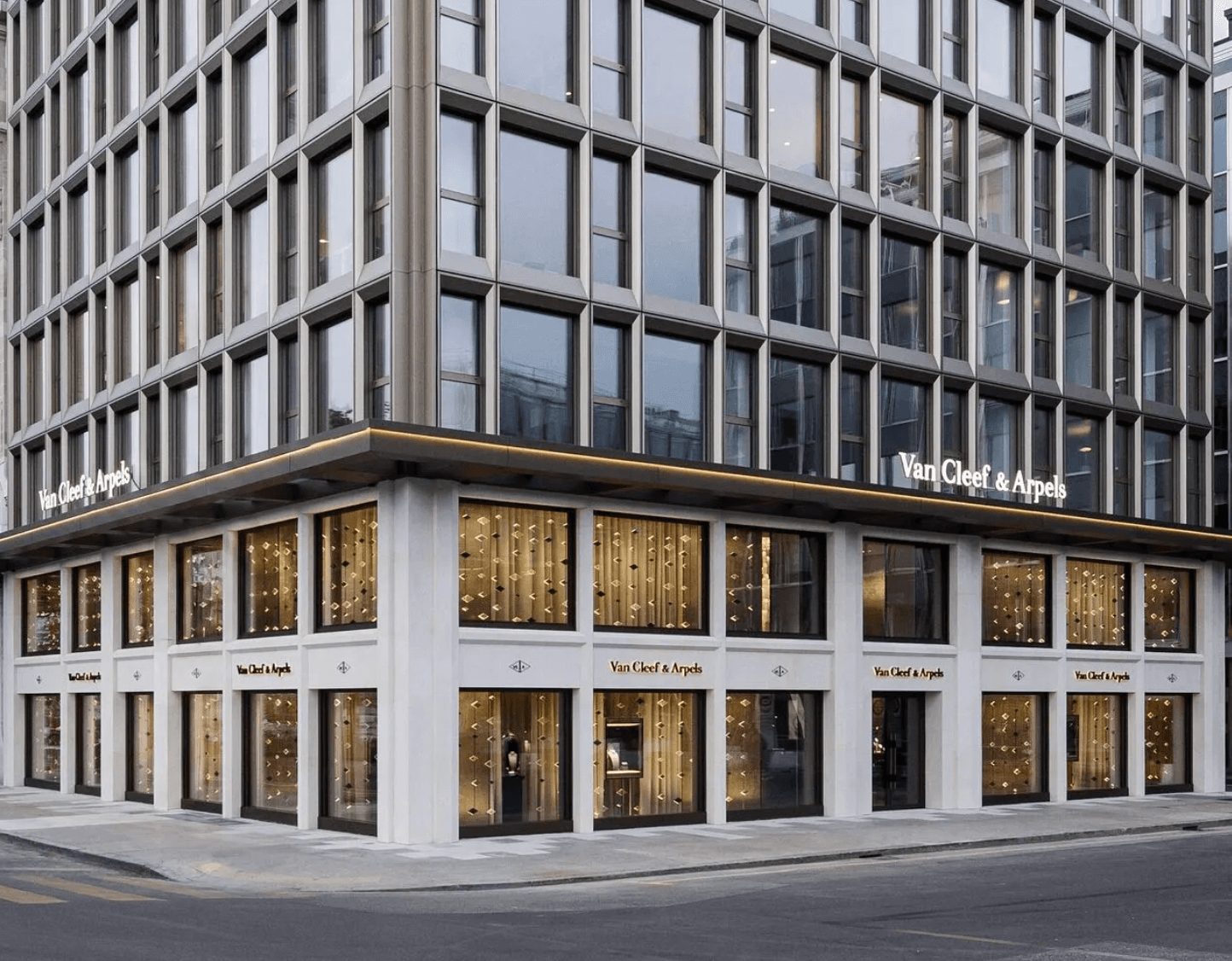
Van Cleef and Arpels has opened a new flagship boutique at 23 Rue du Rhone in Geneva, a two level space of roughly 486 square meters that looks out over Lake Geneva. The boutique carries the house high jewelry collections and is also hosting a rotating exhibition that runs through October, turning what could have been a straightforward store opening into a cultural stop in its own right. The investment lands at a moment when luxury spending has grown noticeably more selective, and it signals that heritage jewelry houses still see a flagship as a brand statement worth funding even when shoppers are pickier.
A flagship built to be a destination, not just a store
The choice of address matters here. Rue du Rhone sits among Geneva watchmaking and jewelry royalty, and a waterfront view gives the boutique a setting that a mall storefront simply cannot match. Pairing that location with a museum style exhibition rather than a purely commercial launch suggests Van Cleef and Arpels wants visitors to treat the space as a place to spend time, not just a counter to browse on the way somewhere else.
That approach mirrors a wider shift now visible across luxury retail. Brands are increasingly building stores around place and participation, betting that a memorable visit builds loyalty in ways a transaction alone cannot.
Tiffany and Bvlgari lean into the same playbook
Tiffany and Co. offered its own version of that idea in Chengdu, staging a participatory exhibition tied to the Qixi festival that invited visitors to create rock paper scissors portraits rather than simply walk past display cases. The activation arrives as LVMH Watches and Jewelry, the division that includes Tiffany, posted organic growth of roughly nine percent in the first half of 2026, with double digit gains in the second quarter alone, a sign that experience driven marketing is tracking alongside real sales momentum rather than substituting for it.
Bvlgari took a different route toward the same goal at its resort in Dubai, converting its existing cafe into La Terrazza, a Mediterranean style terrace serving pizza and gelato. The move extends the brand beyond jewelry and into a lifestyle setting where guests can linger, eat, and associate the name with more than what sits inside a display case.
Streetwear and fashion houses borrow the same lifestyle logic
The pattern is not confined to fine jewelry. HUMAN MADE opened its third Seoul boutique inside Jamsil Lotte World Mall, built around a celadon tile design that nods to Korean craft traditions rather than importing a generic template. KARL LAGERFELD opened its first branded cafe in Amsterdam alongside a pop up store, giving the label a physical, food and drink anchored presence in a city where it previously had none. Giorgio Armani, meanwhile, unveiled its Mare 2026 campaign centered on Mediterranean destinations and opened a new boutique in Mykonos to match, tying the marketing story directly to a real, visitable location.
Collaborations and calendar moments keep the momentum going
Beyond flagship openings, brands are also using collaborations and set piece events to stay visible. Wrangler and LoveShackFancy released a nineteen piece denim capsule priced between seventy nine and two hundred thirty nine dollars, launching August 5. LVMH confirmed that Les Journees Particulieres, its open house event across the group's maisons, returns October 16 through 18, 2026, spanning 65 sites in 11 countries. At Copenhagen Fashion Week, CIFF hosted live scarf personalization from VILA, giving attendees a hands on souvenir rather than a passive show.
Why the details add up to more than a busy week
Taken individually, a Geneva flagship, a Chengdu exhibition, a Dubai terrace, and a denim capsule look like unrelated headlines. Taken together, they describe a consistent strategy. Heritage and fashion brands are leaning on lifestyle extensions, unexpected partnerships, and storytelling rooted in a specific place to stay relevant with shoppers who now expect more than a well merchandised shelf. For jewelry houses in particular, where the product itself rarely changes fast, the store and the moment built around it have become one of the few places left to say something new.