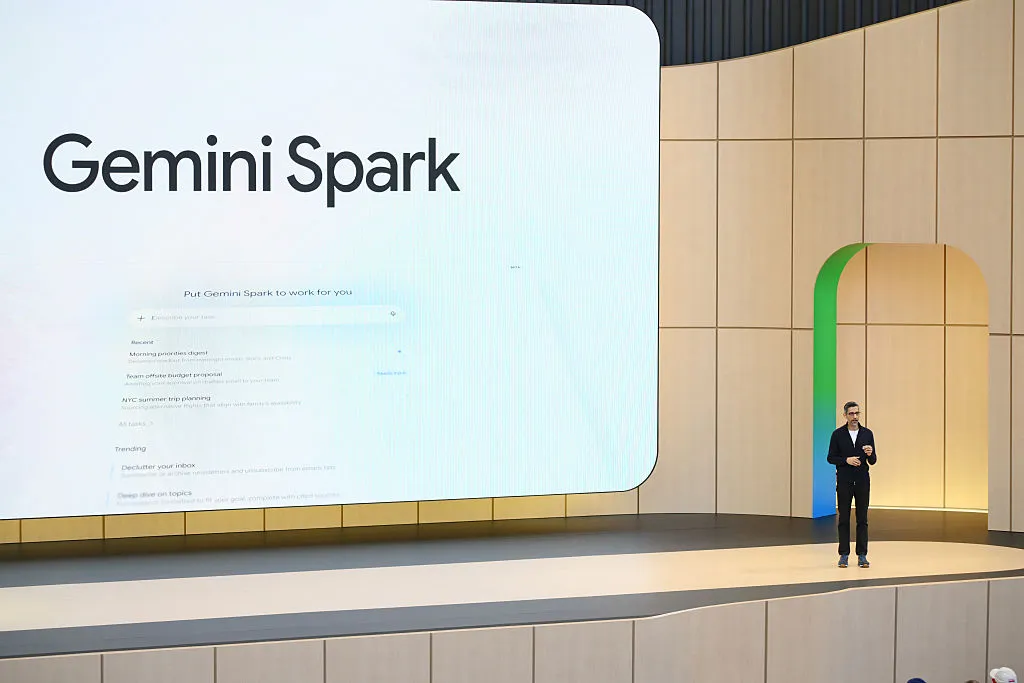
Google used this week's announcement of new Gemini Live voice features to make a promise, that people should not have to guess whether a task calls for Spark, a Daily Brief, or a quick inbox search. It is a fair goal. It is also undercut by Google's own product, which has quietly given nearly every capability inside Gemini its own name, icon, and identity, turning a single assistant into a small collection of competing sub brands.
Three names for one assistant
Open the Gemini app and users are asked to move between chat, Spark, and Daily Brief, three distinct features each occupying its own spot in the navigation. Rather than one assistant that quietly figures out what a request needs, the app hands the decision back to the user, who first has to learn what each named mode is for. That extra layer clutters an experience that could otherwise feel simple, and it hints that Gemini has yet to settle on the one feature confident enough to carry the whole product.
When personalization starts to feel like surveillance
Daily Brief is the clearest example of the problem. It is pitched as an AI powered agenda that pulls from Gmail and Calendar to deliver proactive, personalized updates, the kind of feature an engineer would find clever on a whiteboard. In practice it struggles to tell the difference between something genuinely urgent and an unsolicited nudge, at times resurfacing searches a user ran on Google days or weeks earlier. Being reminded of a task on your calendar is useful. Being quietly reminded that you once searched something personal is not, and the feature blurs that line in a way that reads as invasive rather than helpful.
Spark has the opposite problem
Spark is, by most accounts, one of the genuinely useful parts of the Gemini app, an agent capable of taking real action on a user's behalf. The trouble is that Google chose to package a useful capability as its own standalone brand rather than folding it quietly into the assistant. Google engineers may enjoy shipping something called Spark internally, but the average person opening an AI app has no reason to think about which named mode they are supposed to be in. They should be able to type what they need and let the system decide, on its own, whether the job calls for spinning up an agent.
This is not just a Google problem
Gemini is far from alone here. Anthropic's Claude asks users to pick between chatting with it or handing a task to something called Cowork, and until this week those two modes inside the same app did not even share memory of earlier conversations. OpenAI's ChatGPT follows a similar pattern, requiring people to swap between a mode called Chat and one called Work. Across the industry, AI companies keep exposing their internal product architecture directly to the people using it, asking ordinary consumers to memorize brand names for what are really just different interaction modes running on the same underlying model.
Apple and a wave of texting assistants point the other way
Apple's comparatively quiet approach to Siri may end up looking smart precisely because it asks nothing new of users. Device owners do not have to learn a fresh interface or a new vocabulary of feature names, Apple has simply made the apps people already reach for, Spotlight Search, Photos, the camera, and voice requests, quietly smarter in the background. A similar logic appears to be fueling a wave of text based AI assistants, services such as Poke, Ollie, Lindy, Orchid, Lucas, Folk, Tomo, and Instinct, all built around the idea that people would rather text a helper the way they text a friend than learn to navigate a branded suite of app modes. As one venture investor focused on consumer AI put it recently, most people do not want to open an app every time they need help, they want something they can message the way they already message anyone else, with a messaging thread as the interface rather than a menu of named features.
Good branding hides complexity, it does not showcase it
The pattern across Gemini, Claude, and ChatGPT points to a branding instinct borrowed from software engineering rather than consumer product design, where every internal team wants its work to carry a name and a face. For a mainstream user, that instinct backfires. A product name should describe a benefit someone wants, not the org chart behind it. The AI companies that end up winning everyday trust may be the ones willing to let a single, well branded assistant absorb dozens of capabilities quietly, instead of asking their users to become fluent in an internal map of sub brands just to get something done.